The Economics and Practicality of a Car Pool Dubai Monthly Strategy
Last November, stuck at the Hessa Street bottleneck for the fourth time that week, I ran the numbers on my dashboard. Between Salik tolls pinging my phone and the creeping fuel gauge, my solo daily commute from Dubai Silicon Oasis to Media City was hemorrhaging cash. It hurts. Specifically, it hurts your wallet and your psychological well-being. This logistical friction led me to evaluate alternatives, pivoting entirely away from solitary driving toward structured, shared transit. The concept of a car pool Dubai monthly arrangement is not merely a cost-saving tactic. It represents a fundamental shift in how urban professionals interact with the emirate’s expanding infrastructure.
| Commute Factor | Solo Driving | Car Pool Dubai Monthly |
|---|---|---|
| Average Monthly Cost | AED 1,500 – 3,000 (Fuel, Salik, Wear) | AED 600 – 1,200 (Flat Subscription) |
| Cognitive Load | High (Navigating traffic, parking anxiety) | Low (Passive travel, work-ready state) |
| Environmental Impact | High Per-Capita Carbon Footprint | Significantly Reduced Emissions |
| Legal Compliance | Standard Licensing | Requires RTA-Approved Operators |
Why a Car Pool Dubai Monthly Setup Outperforms Solo Commuting
Examine the mathematics of daily transit. The standard argument against abandoning your personal vehicle usually centers around flexibility. People crave the autonomy to leave whenever they desire. However, that autonomy carries a severe premium. When you calculate the true cost of ownership in this city, the numbers tell a sobering story. An average mid-sized sedan covering 80 kilometers daily consumes roughly AED 800 in fuel per month. Add a conservative AED 400 for Salik tolls crossing multiple gates on Sheikh Zayed Road. Factor in parking fees, which in commercial hubs like DIFC or Downtown can easily exceed AED 1,000 monthly if your employer does not provide a designated bay. Suddenly, the base cost of moving your physical body to a desk sits at AED 2,200. This does not even touch depreciation, insurance, or maintenance amortization.
Shifting to a car pool Dubai monthly model truncates these expenses violently. By distributing the operational costs among four to seven passengers, the per-capita financial burden shrinks. You transition from a variable, unpredictable expense model—where a sudden surge in global oil prices dictates your disposable income—to a fixed, predictable monthly outlay. Predictability is the cornerstone of robust personal finance. Furthermore, stripping away the mental fatigue associated with defensive driving translates directly into retained energy for your actual profession. You arrive fresh. You do not arrive vibrating with residual road rage.
Navigating the Legal Framework: Carpooling in the UAE
Before abandoning your keys, you must understand the regulatory environment. The Roads and Transport Authority (RTA) heavily regulates passenger transport to ensure public safety and fair market practices. Operating an unlicensed, ad-hoc taxi service using your private vehicle is strictly prohibited and carries a fine of AED 3,000. The authorities actively monitor illegal ferrying. Therefore, organizing a casual, paid lift-sharing scheme via social media groups is a massive legal risk. The legislative scaffolding here is designed to protect consumers from uninsured, unvetted drivers.
This stringent oversight is precisely why utilizing licensed, professional services is non-negotiable. The RTA officially supports shared transit when executed through proper channels. For historical context on transport regulations and official guidelines, referencing the RTA official portal provides essential clarity. Commuters must rely on certified operators who carry the correct commercial insurance, utilize appropriately registered vehicles, and employ drivers with specific permits. Choosing an established provider completely insulates you from legal ambiguity while delivering the shared-transit benefits.
Evaluating Monthly Ride-Sharing Economics
Let us break down the economic efficiency further. When negotiating a monthly carpool service in Dubai, the economies of scale become highly visible. A professional service aggregates demand. They map out high-density residential zones—such as Jumeirah Village Circle, Al Nahda, or Discovery Gardens—and link them with commercial epicenters. Because the routes are optimized via algorithmic planning, empty mileage is minimized. This operational efficiency is passed down to the consumer in the form of competitive subscription rates.
Compare this to owning an SUV. Many expatriates arrive in the UAE and immediately finance a large 4×4. The monthly loan repayment alone hovers around AED 3,500. Add comprehensive insurance and the inevitable set of new tires every two years. The financial anchor is massive. By adopting a monthly ride-sharing approach, you liquidate that anchor. You buy back your liquidity. I have consulted for mid-level managers who redirected their theoretical car allowance entirely into investments, utilizing a premium carpool service for mobility. The wealth generation over a three-year period, simply by avoiding vehicle depreciation, is staggering.
The Hidden Costs of Solo Driving
We rarely price our own time accurately. If you spend ninety minutes a day gripping a steering wheel, that is ninety minutes of lost productivity. Over a twenty-two-day working month, you are sacrificing thirty-three hours. That is nearly an entire workweek consumed by navigating asphalt. In a shared transport environment, that time is reclaimed. You can answer emails, read industry reports, or simply close your eyes and listen to a podcast. The conversion of dead transit time into usable, productive time is perhaps the most compelling argument for making the switch.
Choosing Your Car Pool Dubai Monthly Provider
The market for shared transit solutions is expanding, but quality varies wildly. Selecting the right partner dictates whether your commute becomes a seamless background process or a daily frustration. You must scrutinize the provider’s logistical capability. Do they offer guaranteed seating? Is there a strict maximum passenger limit to ensure comfort? What is their contingency plan if a vehicle breaks down? These are the operational stress points that separate premium providers from amateurs.
My recommendation for a frictionless transition is to utilize established platforms that prioritize both tech integration and fleet quality. For instance, exploring monthly carpool solutions through reliable operators ensures you receive business-class reliability. A proper provider will offer app-based tracking, transparent billing, and a diverse fleet tailored to the specific route requirements. They understand that reliability is not a luxury; it is the fundamental product they are selling.
Fleet Quality and Maintenance Standards
Never underestimate the importance of fleet condition. In a climate where summer temperatures exceed forty-five degrees Celsius, air conditioning performance is a critical safety and comfort metric. Professional operators adhere to strict preventative maintenance schedules. They rotate tires, inspect brake pads, and sanitize cabins daily. When assessing a Dubai monthly ride-sharing option, inquire about vehicle age. Fleets younger than three years generally provide a superior, quieter ride, directly contributing to the stress-reduction aspect of the commute.
Environmental Impact: The Urban Sustainability Angle
Beyond individual economics, we must address the macro-level impact of our transit choices. The UAE is aggressively pursuing green initiatives, highlighted by its hosting of COP28 and its commitment to net-zero emissions by 2050. The proliferation of single-occupancy vehicles is geometrically opposed to this vision. A staggering percentage of cars on Sheikh Zayed Road carry only one person. This represents an abysmal failure of energy efficiency. Every liter of combusted fuel generates roughly 2.3 kilograms of CO2.
Consolidating five commuters into a single vehicle slashes the per-capita carbon footprint of that journey by eighty percent. Multiply that by tens of thousands of daily commuters, and the environmental relief is profound. The UAE sustainable urban development master plan heavily emphasizes reducing traffic density and promoting shared mobility networks. Participating in a structured monthly carpool is a direct, actionable way for residents to align their personal habits with national sustainability goals. It is a pragmatic application of environmental consciousness that requires zero sacrifice in comfort or efficiency.
The Psychology of the Commute: Stress Reduction Through Shared Transit
Traffic congestion is a recognized physiological stressor. When you operate a vehicle in heavy traffic, your body releases cortisol. Your heart rate elevates. Your peripheral vision hyper-focuses, maintaining a state of continuous low-grade alert. Subjecting yourself to this state twice a day fundamentally alters your baseline anxiety levels. I have seen highly capable executives arrive at morning meetings already depleted, their patience eroded by a near-miss at a roundabout.
Delegating the driving responsibility neutralizes this threat. Clinical studies regarding urban mobility indicate that passive commuting significantly lowers self-reported stress levels. Research accessible via platforms like the National Institutes of Health clearly correlates long, active driving commutes with negative health outcomes, including hypertension and chronic fatigue. By opting into a monthly commuter transport system, you physically distance yourself from the mechanics of the commute. You observe the traffic rather than fight it. The psychological return on investment here cannot be overstated.
Productivity Gains in a Car Pool Dubai Monthly Arrangement
Consider the modern workday. It rarely begins when you sit at your desk; it begins the moment you wake up. The ability to triage your inbox while rolling down Al Khail Road provides a massive tactical advantage. You clear the administrative debris before arriving at the office, allowing you to dedicate your peak morning energy to deep, focused work. Alternatively, you can use the transit time for mental decompression. Meditation, reading, or simply enjoying silence. The shared vehicle becomes a transitional airlock between the personal and professional spheres.
Route Optimization and Technology in Modern Transit
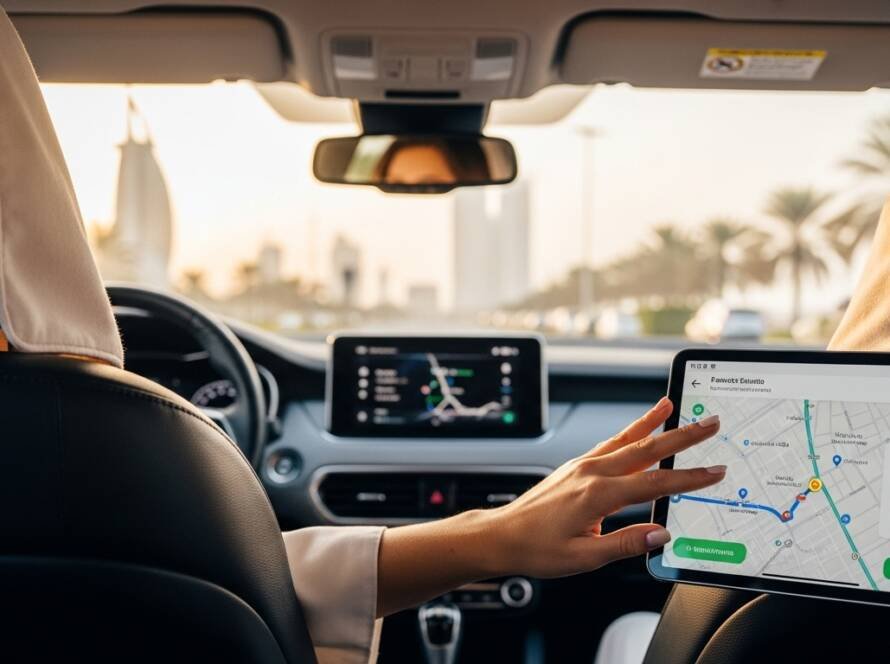
The backbone of any successful monthly carpool service is its routing algorithm. Legacy transport systems relied on static bus routes that forced passengers to adapt to the infrastructure. Modern private operators invert this model. They utilize dynamic routing software that analyzes the GPS coordinates of subscribed passengers, plotting the most efficient path of extraction and delivery. This minimizes deviation time.
These algorithms also account for real-time traffic data, historical congestion patterns, and weather anomalies. If an accident severely limits flow on the primary highway, the software instantly reroutes the driver through secondary arterial roads. This level of logistical agility is impossible to achieve in a rigid, ad-hoc system. It requires serious computational power and dedicated fleet management. When you pay for a premium subscription, you are not just renting a seat; you are leasing access to this optimization technology.
Corporate Adoption of Monthly Carpool Programs in Dubai
The business-to-business (B2B) applications of this model are gaining massive traction. Human Resources departments across the emirate are realizing that commute friction is a major contributor to employee turnover. When an employee spends two hours a day in traffic and spends thirty percent of their housing allowance on transport, they eventually seek opportunities closer to home. Retention suffers. Furthermore, companies based in premium locations face severe parking constraints. Leasing additional corporate parking spaces is exorbitantly expensive.
Forward-thinking organizations are now subsidizing car pool Dubai monthly subscriptions as a core employee benefit. It is a strategic masterstroke. The company reduces its requirement for leased parking, actively improves employee punctuality, and boosts morning morale. It also satisfies corporate social responsibility (CSR) mandates by demonstrably reducing Scope 3 emissions. I assisted a logistics firm in Jebel Ali last year in transitioning sixty of their mid-level staff to a corporate shared transit model. Within three months, late arrivals dropped by forty percent, and employee satisfaction surveys reflected a massive appreciation for the reclaimed personal time.
Designing a Subsidized Car Pool Dubai Monthly Framework
Implementing a corporate program requires structured planning. Organizations should begin with a geographic density analysis of their workforce. Identify clusters of employees living in similar neighborhoods. Negotiate enterprise rates with reputable fleet operators. Determine the subsidy level—whether the company covers the full cost or operates on a co-pay model. Crucially, the program must remain optional, but the financial and psychological incentives should heavily encourage adoption. Internal marketing is key here. Frame the initiative not just as a transport solution, but as a lifestyle upgrade.
Future-Proofing Urban Mobility in the Emirate
The trajectory of urban transit in the region is clear. As the population scales toward the projections outlined in the Dubai 2040 Urban Master Plan, single-occupancy vehicle travel will become increasingly untenable. We will see tighter regulations, higher toll implementations, and possibly dynamic pricing for road usage during peak hours. The infrastructure will prioritize mass transit, autonomous networks, and high-occupancy vehicle (HOV) lanes. Adopting a shared mobility mindset today prepares you for the inevitable regulatory shifts of tomorrow. You establish routines and preferences that align with the future state of the city’s transport ecosystem.
Final Executive Thoughts
The mathematics, the legal realities, and the psychological data all point toward a singular reality: the solo daily commute is an antiquated, inefficient habit. Transitioning to a structured car pool Dubai monthly setup is a rational, data-driven decision. It preserves capital, protects mental bandwidth, and aligns with the broader infrastructural evolution of the city. As professional operators continue to refine their tech stacks and elevate fleet quality, the friction of moving away from private vehicle reliance disappears completely. The real question is no longer why you should share your commute, but rather how long you can afford the hidden costs of driving alone.